‘Baiya-Toiya’ and the Aspirational Middle Class Nationalist Imaginary: Shifting Axes of Political Polarization in Sri Lanka
Introduction
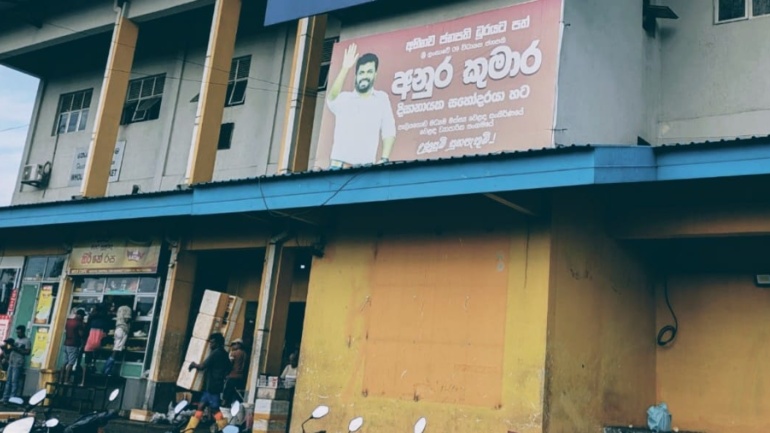
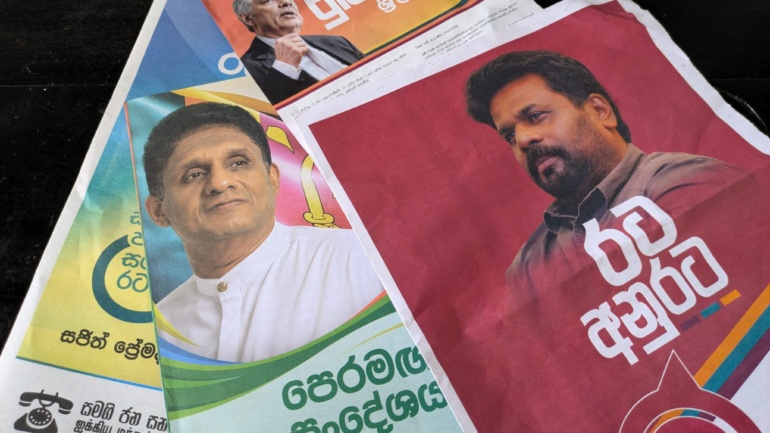
Following the 2022 economic crisis and popular protests, which ousted President Gotabaya Rajapaksa, Sri Lanka’s political space has undergone major shifts. The National People’s Power (NPP), previously a distant third force in Sri Lanka’s party system, secured a decisive mandate at the 2024 national elections, due to the success with which it embraced and mobilized a populist and anti-establishment narrative of the corrupt elite versus the non-corrupt masses.[1] This shift in political polarization has raised important questions about its impact on Sinhala Buddhist nationalism, which has been the dominant political ideology and provided the main axis of polarization, especially since the end of the war in 2009.
Since the 2022 crisis, Sinhala Buddhist nationalist discourse has failed to gain significant traction politically. Previously, popular frustrations over economic inequality and restricted avenues for social mobility were often deflected onto an ethnic or religious ‘other’ through nationalist discourse. The large-scale mismanagement of public finance and other structural weaknesses that led to the economic crisis, and the economic pain and its disproportionate impact on masses brought about by the IMF-led reforms spearheaded by the government formed by the coming together of the old guard Wickremesinghe and Rajapaksa camps, strengthened anti-establishment sentiments among the people.
The political delegitimization of the political old guard that had been in government before had reached a high point, such that neither ethno-nationalist slogans nor countering them played a major role in defining election campaigns could gain much traction. At the narrative level, the unifying, anti-establishment message of the Aragalaya in 2022 sufficiently disrupted dominant Sinhala Buddhist nationalism associated with the old guard of the Rajapaksas, in particular, seeing a temporary decline in influence of the narrative and its articulators since.
One of the key features of the political space during the 2022 crisis in Sri Lanka was the consolidation of a liberal consensus committed to liberal market reforms and a liberal peace framework.[2] During the first phase of such a liberal consensus which emerged since 1994, one of its consequences was that it created a conservative vacuum, which was captured by ultra-nationalist parties and ultimately, consolidated by the Mahinda Rajapaksa government in 2005. In the contemporary Sri Lankan context, where a form of liberal consensus is evident in the majority support for economic liberalization reforms and muted nationalism, the trajectory of the ‘nationalist’ camp and its proponents need to be closely analyzed.
In this chapter, we explore the following central question: What is the likely trajectory of Sinhala Buddhist nationalism in Sri Lanka as a political slogan, given the rise of the NPP, which has shifted the axis of political polarization from a focus on ‘nationalism’ to one driven by ‘anti-establishment’ sentiments, largely fueled by opposition to corruption? We argue that the NPP has shifted the primary axis of polarization from traditional majoritarian nationalist rhetoric to a discourse centered on anti-establishment and anti-corruption sentiments, driving a form of ‘transformative repolarization’.
Key Conjunctures in Sinhala Buddhist Nationalism
Sri Lanka’s ethno-religious nationalism was shaped by local anti-colonial struggles, led by an elite that emerged during the colonial period through state patronage and education that the British developed.[3] The ethno-religious nationalism driven by the revivalist movement was significantly suppressed following colonial intervention after the 1915 Sinhalese Muslim riots. In its place, the more Westernized Ceylon National Congress (CNC) gained prominence, advocating a legalistic and procedural approach to negotiating greater power for the local elite from the imperial authorities.
The CNC later led to the formation of the United National Party (UNP) that was founded in 1946. The UNP, in turn, formed the first government in the dominion of Ceylon and manifested one version of Sri Lanka’s nationalist thinking. The UNP government brought together the Tamil nationalist party, the All Ceylon Tamil Congress, and Muslim leaders and appointed a multi-ethnic cabinet of Ministers under the Premiership of D. S. Senanayake, which adopted right-of-center economic policies that were tilted towards the CNC’s pro-dominion stance. This involved state building with a Sinhala majoritarian bias, such as the state-sponsored Gal Oya peasant colonization schemes, as seen during the Donoughmore administration in Ceylon from 1931 to 1947.
The country’s single party dominance ended in 1956, with the electoral victory of the Mahajana Eksath Peramuna (MEP).[4] In contrast to the CNC, the main political party within this coalition, the Sri Lanka Freedom Party (SLFP), was an evolution of the Sinhala Maha Sabha, a left-leaning political movement manifesting Sinhala majoritarianism and full independence of the country. The passage of the Sinhala Only Act marked a turning point and Sinhala cultural nationalism was consolidated as the dominant political force. The 1956 elections empowered a rural Sinhala elite, comprising the pancha maha balawegaya (a campaign platform based on the five-pillared force made up of indigenous doctors, monks, teachers, farmers, and workers). A class critique of the electoral shift in 1956 was often interpreted as a victory of the petit bourgeoisie by scholars such as Kumari Jayawardene and S. B. de Silva.[5]
Following the 1956 Sinhala Only Act, successive SLFP-led governments introduced other majoritarian and populist policy measures through the 1960s and 1970s, when the domestic economy was stagnating, employment became scarce, and unrest among youth was rising. These policies included standardization of university entrance requirements, privileging Sinhala students over Tamil students, and nationalization of land for intended distribution among the landless peasantry.[6]
By the 1980s, the underlying class critique of majoritarian nationalism became overshadowed due to a few critical factors. These include the severe weakening of the political left due to the violent crackdown of the 1980 strike, the delegitimization of political left parties that had formed government with the SLFP in the 1970s (Lanka Sama Samaja Party and Communist Party), and state repression against the main opposition center-left party (such as house arrest of former PM Sirimavo Bandaranaike). Moreover, the Janatha Vimukthi Peramuna (JVP) made inroads into the left political and ideological space with a nationalist tilt, and Tamil militancy was on the rise, especially since the mid-1970s, with the assassination of Jaffna’s Mayor.[7]
Under the more right-leaning, liberal UNP government, the 1980s also witnessed the dominance of the liberal democratic model, benchmarking the quality of democracy and the performance of liberal democratic institutions, an approach closely aligned with international development agencies (such as the World Bank and IMF) promoting good governance and participatory democracy at the time. This marked a significant turn away from structural critiques of capitalism and class politics, moving instead toward frameworks compatible with liberal democratic norms and donor-driven development paradigms.
Following the 1983 anti-Tamil violence under the J. R. Jayawardene UNP government, scholarly focus in Sri Lanka made an ‘identitarian’ and ‘culturalist’ turn, increasingly shifting toward nationalism, identity politics, and the struggle for political rights. Since the 1980s, much of this ‘liberal’ scholarship on Sri Lanka has tended to frame Sinhala nationalism as its primary ‘antagonist’, reducing a complex discourse to a dominant reading of nationalism in Sri Lanka as a bipolar ethnic conflict.[8]
One of the key consequences of this was a marked decline in academic and political attention to material conditions and class politics in Sri Lanka, and how this informed Sinhala Buddhist nationalism. The national-populist rejection of Marxism as a colonial import was evident within the Jathika Chintanaya movement which gathered momentum in the 1980s. During this period, the discourse of Sinhala Buddhist nationalism clearly reflects an affective valorization of the countryside over the city.[9] This ‘maintenance of [a] rural partition’ within populist discourse has been integral to maintaining political legitimacy and served as a significant ideological reaction to the uneven development of capitalism across different spatial scales.[10] The 1980s marked the initial phase of neoliberal development reforms, during which the forces of globalization and urbanization triggered a strong backlash from nationalist groups, expressed through the popular slogan ‘Protect the Motherland’ (Mawbima Surakimu).
These forces were momentarily sidelined in the 1990s. During President Chandrika Kumaratunga Bandaranaike’s first term in 1994, Sri Lanka witnessed a significant political and economic shift. The two major political blocs, the SLFP and the UNP, reached a liberal consensus that acknowledged the country’s ethnic conflict and supported the pursuit of a peace process. This period marked the second phase of economic liberalization, framed as an “open economy with a human face”, influenced by the global neoliberal wave of the 1980s and ongoing economic restructuring under IMF guidance.
Within this context of liberal consensus, where economic deregulation and a political resolution to the ethnic conflict were seen as inevitable, a political vacuum emerged. This void was eventually filled by smaller, fringe political parties and movements, notably the Sinhala-nationalist breakaway faction of the UNP, Sihala Urumaya (later the Jathika Hela Urumaya or JHU) and the JVP. Although these groups secured only a marginal share of the vote at elections when competing alone, they significantly influenced national discourse on the war and ethnic relations well into the 2000s, by forcing main political parties to build coalitions with them, or make significant compromises to their narratives, to resemble them. Their growing influence laid the groundwork for Mahinda Rajapaksa’s rise to power, enabling his administration to pursue a military solution to end the war. His government adopted a development model centered on renationalizing state-owned enterprises, expanding infrastructure through foreign loans, primarily from private creditors, and heavily subsidizing a new class of domestic business elites aligned with the state.
Despite this political economy model of majoritarian patronage becoming entrenched as the war intensified, the majority of scholarship remained focused on the authoritarian excesses that Sinhala Buddhist nationalism permitted and the ethnic othering and violence that it unleashed in the name of ‘nation building’. The end of the war in 2009 created an ‘ideological breathing space’, reducing the immediate ethical pressure to confront nationalist excesses and to revisit the contemporary history of Sri Lanka from a class perspective.[11] This discourse was largely led by civil society in the absence of strong leftist political parties that were able to mobilize class politics. By this period, the old left parties – such as the Lanka Sama Samaja Party and Communist Party – had long lost their left ideological edge due to their alliances with the center-left SLFP. The JVP too had been in coalition governments with the SLFP and backed, directly or indirectly, political candidates from both the SLFP and UNP-led coalitions.
The ‘post-nationalist’ turn in the post-war era is articulated as the Sinhala psyche developing in both countering the Tamil imagination of ‘homeland’ in the north and the east of Sri Lanka and in coping with the uneasy recognition that hundreds and thousands of lives have been lost due to the violence unleashed during the war.[12] Dewasiri argues that the first narrative aims to reinforce Sinhala Buddhist territorial hegemony, while the second seeks ideological balance to engage with Tamil nationalist moral claims.
In the post-war context, intensifying social contradictions inherent in capitalist development were shown to introduce new complexities to state–society relations.[13] Among key policy domains on which this dynamic can be observed are land policy, the economic exploitation of the North and East, labor policy, and inequality. The consequences emerging from these areas are poised to compound existing challenges, most notably creeping authoritarianism, deteriorating social policy, and the unresolved national question.[14] The post-war period also saw the re-emergence of political networks and tactics that reflect a deeper historical trajectory of political society in Sri Lanka. This unfolded within a context of weakened civic nationalism and entrenched patterns of patronage-based politics, where there is simultaneously a curtailment of ‘the political’ (the ruling out of certain forms of antagonism) and an intensified ‘politics’ (elbowing for patronage).[15]
During this period, Sinhala nationalism has increasingly drawn from a technocratic and urban aesthetic, moving away from its earlier pastoral and agrarian roots.[16] This transformation reflects a broader shift in the cultural politics of nationalism as well, now rooted more in middle-class urban imaginaries than rural idealism. Simultaneously, the construction of the ethnic ‘other’ in Sinhala nationalist thought has also increasingly targeted the Muslim community, evident in the rise in anti-Muslim riots and Islamophobia in the post war context. This convergence of political, cultural, and ideological shifts marks a critical reconfiguration of post-war Sri Lankan nationalism, where new forms of exclusion and domination are legitimized.
The Politics of Polarization in Sri Lanka
Political polarization dovetails with the singular narratives and exclusivist claims advanced often by nationalist political campaigns that are closely aligned with an ethnic, religious, or ‘civilizational’ group. This dynamic becomes especially dangerous when populist leaders instrumentalize nationalism to exacerbate exclusion, often triggering backlash from displaced elites (the old political and economic guard) in response to the political incorporation of marginalized groups. The result is heightened identity conflict and a weakened democratic pluralism.[17] As a process, polarization simplifies complex political landscapes into binary moral oppositions, reducing the space for nuance.[18] In doing so, it entrenches a political environment in which neither side has incentives to reduce conflict, allowing polarization to persist until disrupted by external shocks or major political realignment.
With the consolidation of a dominant neoliberal development paradigm, there has also emerged increasing distortion of political ideologies, with center-right and center-left politics offering less distinct alternatives. This has meant that the politics of polarization sometimes elude traditional ideological categories, making it harder to identify and counteract effectively. This has often meant that while anti-elite narratives are mobilized, the policy translation is often lacking and issues such as inequality persist or worsen. Over time, this leads to fatigue and negative connotation of populist politics. Populist entrepreneurs too provide alternative theories to explain their depravity, framing it as an outcome of an economic conspiracy by a self-serving elite, cultural decadence due to nouveau-riches, or capture by cult groups. This illustrates the ‘capture’ of populist politics on both ends of the spectrum.
Our analysis draws from Somer and Tekinirk’s (2024) framework which distinguishes between reactive and proactive counter-polarization strategies.[19] Reactive strategies, including reciprocal polarization and passive depolarization, typically aim to restore a previous political order. However, they often reinforce or legitimize authoritarian tendencies by either mimicking polarizing tactics or failing to challenge existing divisions. In contrast, proactive strategies such as transformative repolarization and active depolarization seek to reshape political conflict around inclusive, democratic values.
In Sri Lanka, the post-war politics of polarization consolidated along the lines of patriots vs traitors. The second presidential election of Mahinda Rajapaksa marked the introduction of this axis following the military defeat of the LTTE in 2009. In this address to the parliament, he stated: “No longer are there Tamils, Muslims, Burghers, Malays and any other minorities. There are only two (groups of) people in this country. The people that love this country. The other comprises the small groups that have no love for the land of their birth”.[20]
This statement marked an advanced point in the Sinhala majoritarian narrative, where Tamils, and now Muslims, were mainly framed as the new ‘other’. Under this new order, election outcomes and social polarization took place along the same lines. Post-independence Sri Lanka’s democratic discourse depended on two key themes, namely, delivery of development and solution to the national question. With the above statement, Mahinda Rajapaksa’s government attempted to erase the pillar of the national question from the discourse, framing the post-war Sri Lanka’s trajectory as having no distinct ethnic problem to deal with, but only a problem of development. On this promise of accelerated development, militarization in the North and securitization of civil life thrived in the post-war era, as the military became an open agent of the state’s capitalist ambitions.[21]
Electorally, this period was marked by polarizing elections along ethnic lines, with the Rajapaksa electoral machine relying on its popularity among the majority of Sinhala voters to secure a winning edge. Meanwhile, the opposition operated within the same framework of polarization, leading to a form of passive depolarization, depending on their overwhelming popularity among the ethnic minority groups while maintaining a sufficient swing within the Sinhala voters towards them. Electoral maps in 2010, 2015, and 2019 presidential elections manifest this polarization.
This brazen majoritarian polarization since 2010 can be understood by juxtaposing it with the 2005 presidential campaign. In that election cycle, when it was politically expedient to not acknowledge the prevailing ceasefire with the LTTE, the Rajapaksa’s election campaign relied on the evasive rhetorical trope ‘honorable peace’ with regard to the nation, without taking an overt position either on the strategy to address the ‘issue of LTTE’ or the national question.[22] The election platforms were less polarized on ethno-religious and majoritarian lines prior to 2010. The Rajapaksa campaign displayed more nationalist and majoritarian symbolism in its campaign, such as platforming political parties and organizations (JVP and JHU) that advocated for a military solution to the ethnic conflict, and Buddhist monks.
However, the opposition campaign of Ranil Wickremesinghe’s presidential bid also platformed a significant amount of nationalist symbolism, including the key campaign song.[23] Such markers of nationalism were significantly absent from Rajapaksa’s opposition political campaigns by the 2010 election cycle, reflecting the hegemonization of nationalist narratives by the Rajapaksa camp and the consolidation of the ‘patriots vs traitors’ narrative. As the second term of Mahinda Rajapaksa led to increased borrowing and infrastructure development projects, the opposition strategy was shaped by trying to undermine the claims of growth by pointing to corruption and depolarizing the political discourse by insisting on the claim that Sri Lanka is a multi-ethnic nation.
Signs of ‘pernicious polarization’ were evident during the second term of Mahinda Rajapaksa’s popularly elected government, marked by the incremental subversion of democracy (Somer & Tekinırk, 2024). This process led to a gradual deterioration in the quality of various democratic domains, including civil society, public discourse, parliament, and the judiciary. Although the opposition strategies since 2010 involved emphasizing the rising corruption, the theme has remained a significant political slogan in Sri Lanka since the 1980s, in parallel to economic liberalization reforms. All elections since 1994 featured a strong anti-corruption narrative; issues of the national question, i.e., power relations between ethnic groups in the formation of the Sri Lankan state, and the ongoing civil war formed the key theme.[24] The anti-corruption narrative was used as a strong arsenal against the Rajapaksa political machine in his second presidential term, with the proliferation of debt-financed development projects. For instance, the presidential election of 2015, which mobilized the prospect of ‘good governance’ as a coded anti-corruption message.
By the time of the presidential election of 2015, the opposition to Rajapaksa politics had been able to reciprocate polarization on the same axis of ‘patriots vs traitors’ to undermine the hegemonic power of the narrative. While the defection of some nationalist groups such as the JHU and JVP to the opposition marked this at the level of political party realignment, this move was enabled by the counter polarization under the National Movement for Social Justice (NMSJ) led by a senior Buddhist Monk Ven. Maduluwawe Sobitha.[25] Emerging as a politically charged social movement, it reshaped opposition strategies by framing corruption, waste, and nationalist excesses as consequences of the executive presidency’s excessive powers. The movement united diverse opposition forces, including groups previously aligned with the government, around the goal of abolishing the executive presidency.[26]
This shift moved political polarization from ethnic divisions to issues of governance and power concentration, drawing support from ethnic and religious minorities as well as segments of the Sinhala middle class. The narrative gained such momentum that even the incumbent president pledged to abolish the executive presidency during the last days of the run-up to the presidential election in 2015.
At the level of political discourse, the repolarization manifested by the association of the culturally derogatory term baiya to President Mahinda Rajapaksa, and to anyone who supported the Rajapaksa political enterprise. The word baiya was successfully mobilized by the anti-Rajapaksa camp when President Mahinda Rajapaksa’s 2014 budget speech was concluded with the phrase “Kohomada game baiyange weda?” (How have I done a villager’s job?), signaling a deliberate reframing of baiya as authentic, resilient, and representative of ‘the real Sri Lanka’.[27]
The anti-Rajapaksa campaign which gathered momentum in the lead up to the 2015 elections was quick to reciprocate by introducing a binary opposition, baiya vs toiya, and to frame the baiya as backward and naive people. The toiya, in contrast, was cast as cosmopolitan, effeminate, and elitist.[28] Toiyas refer to a small demographic within society, primarily made up of individuals from the middle or upper-middle classes, or from elite backgrounds. They often come from families with colonial-era elite status and are typically educated at prestigious schools, many of which have missionary origins. The term has since evolved to signify not only an elite or aspirational lifestyle but also a set of political attitudes aligned with Western liberal values, such as support for open markets and cosmopolitanism. This polarization thrived in the initial years of the 2015–2019 government.[29]
However, demonstrating government paralysis typical of political movements that used ‘reciprocal polarization’ strategies, between 2015 and 2019, the fragile SLFP–UNP coalition suffered from governance paralysis, policy delays, and economic slowdown, exacerbated by institutional overlaps and political infighting. The 2018 constitutional crisis further eroded public trust, weakened the coalition’s reform agenda, and paved the way for the Rajapaksas’ political resurgence.[30] In opposition, effectively using repolarization strategies, the Rajapaksas formed the Sri Lanka Podujana Peramuna (SLPP), mobilizing around nationalist, ethno-religious narratives and fears of international intervention. These themes gained momentum after the 2018 Digana anti-Muslim riots and the 2019 Easter Sunday attacks, which intensified communal divisions. Efforts at “reverse polarization” collapsed, giving way to renewed, Rajapaksa-led authoritarian repolarization in the final years of the coalition government.
Combining the nationalist sentiments with the claim to deliver anti-corruption, a segment of the SLPP launched an unofficial but highly effective version of the campaign theme ‘system change’ that brought Gotabhaya Rajapaksa his presidential electoral victory. It had a strong appeal to end corruption, alongside the main campaign theme of national security.31 Both these aspirations of national security and anti-corruption were encapsulated in the ‘One Country – One Law’ slogan that denied recognition to the socio-cultural identity of the minorities and flagged a narrative on the rule of law.
Post-2022 Shifts in Political Polarization in Sri Lanka
Since the end of the civil war in 2009, and particularly from 2010 onwards, Sri Lanka has experienced over a decade of political instability and shifting electoral majorities. Despite achieving electoral dominance, successive governments have struggled to retain legitimacy and get re-elected. This persistent instability culminated in the 2022 Aragalaya protests, which destabilized the traditional party system and accelerated government turnover, with administrations changing approximately every three years.[32]
A defining feature of this turbulent period has been the emergence of new political lexicons that shape public discourse. Language has become a powerful tool for social exclusion and moral delegitimization. From the post-war binary of ‘patriots versus traitors’ to labels like baiya and toiya since 2015, political vocabulary has been instrumental in framing dissent and stigmatizing difference.[33] These terms represent longstanding practices of ethnic and class ‘othering’, tracing back to the 1983 anti-Tamil pogroms, and remain deeply relevant in the current post-Aragalaya context.
The National People’s Power (NPP), while historically associated with nationalist positions, has gradually repositioned itself as the principal voice of an anti-corruption movement, particularly in the post-2009 era. This anti-corruption narrative gained traction after the Aragalaya, shifting the axis of political polarization from ethnic identity toward a populist framing centered on morality. The traditional divisions gave way to a new binary of the ‘politically corrupt’ versus the ‘non-corrupt’, with class undertones reframed in moral terms.[34]
The NPP now positions itself as a political force seeking to dismantle entrenched, family-dominated power structures and replace them with citizen-led governance. In doing so, it portrays the political elite as self-serving and ethically bankrupt, while presenting itself as the authentic representative of the people. This framing has enabled the NPP to unify diverse segments, most notably working-class communities across ethnic and religious lines, around a shared rejection of corruption and political patronage.[35] Simultaneously, portions of the middle class and business sector, traditionally aligned with liberal economic values, have been drawn to the party’s blend of economic protectionism and anti-corruption reformism.
By pursuing this broader agenda of systemic reform and social contract renewal, the NPP engages in what can be termed transformative repolarization, which is a counter polarization strategy that redefines the political field itself. The shift from ethno-religious to anti-corruption polarization has unfolded gradually across four election cycles (2010-2024), with the 2022 Aragalaya serving as a critical turning point. In this period, the earlier binaries such as baiya vs toiya began to blur, giving rise to hybrid terms like sajabaiya (a baiya who supports the main opposition, the Samagi Jana Balawegaya/SJB), or tobaiya (a toiya adopting baiya-like political views), and jebaiya (a baiya who supports the NPP/JVP). These new terms suggest a political imagination increasingly shaped by anti-establishment sentiments, rather than traditional ethnic or class distinctions, and the fragmentation of the political party and voter constituencies.
During the May 2025 local government elections, the main opposition political parties adopted a shared campaign strategy that frames the NPP government as deceitful, branding them as ‘liars’ (boru) in contrast to the ‘thieves’ (horu) of previous regimes. This rhetorical shift marked the culmination of Sri Lanka’s political realignment onto a new axis of polarization: horu vs boru, rather than a reversal to the nationalist axis of political polarization that dominated the political space previously. The discourse signaled not only the breakdown of older political categories but also the emergence of a moralized populist binary.
A dominant theme since then has been the reframing of the NPP’s anti-establishment and anti-corruption rhetoric as deceptive populism (boru), i.e., of populism that does not deliver on its promises. Nationalist media outlets often depict jebaiyas as lacking ideological consistency and driven by class envy and resentment. This narrative delegitimizes their critique of the political establishment and allows nationalist actors (baiyas) to reclaim the mantle of “authentic” leftist politics. Such discursive strategies seek to undermine the class-based critique central to the Aragalaya movement and reassert a moral order centered on notions of the ‘productive’ and ‘patriotic’ citizen.
The fragmentation of the traditional baiya voter base, once unified under Mahinda Rajapaksa, poses a significant challenge to parties like the SLPP. New platforms such as Sarvajana Balaya are attempting to remobilize this constituency by blending cultural nationalism with economic modernization narratives.[36] However, the NPP’s 2024 landslide victory reflects a broader ideological and generational shift. The inability of the old political elite to deliver economic stability has driven a large section of the electorate toward post-ideological, anti-establishment populism. Even so, terms like jebaiya remain weapons of delegitimization, increasingly used in cultural discourse to discredit dissent and reassert ideological boundaries.
Against this context, the baiya identity remains tightly linked to Sinhala Buddhist nationalism. While some political figures attempt to universalize the label post-2022, suggesting that “everyone is a baiya”, ethnic minorities remain largely excluded from this narrative.[37] This amplification of the term’s applicability to encompass a grand majority of the people, who have their political allegiances with the NPP, SJB, or UNP, is an attempt to rearticulate its political meaning differently from what it meant at the time the term was first introduced in 2014/15 to address Rajapaksa supporters. In that semantic cluster, a toiya would mean a supporter of the UNP-led political camp belonging to the middle class.
However, in the new lexical cluster, the term toiya has been restricted to mean a small minority of elites and cosmopolitan urbanites (including all the ethno-religious minorities). In its new meaning, the term baiya alludes to nationalist sentiments associated with the common locals, co-mingling the ideas of nationalism and the Sinhala masses, mirroring the NPP’s axis of polarization of the people vs corrupt elites narrative. This new and evolving development hints at the need for mapping the developments in nationalism in the post-2022 period.
Nationalism Post-Aragalaya: Proponents and Narratives
Since the 2022 crisis, Sinhala Buddhist nationalist discourse has significantly less political traction. This is likely in part due to the urgency of the ‘economic’ issues, following the 2022 crisis, and the Aragalaya’s unifying anti-establishment message which disrupted the hegemonic narratives that had previously legitimized past governments, most notably Sinhala Buddhist nationalism, leading to their temporary decline in influence. In the 2024 national elections, all three major candidates did invoke some degree of nationalist rhetoric but avoided explicit positions on justice for civil war victims. Despite this, the elections were less polarizing than any since 1994, with no candidate actively weaponizing nationalist themes.
This does not suggest that the Sri Lankan polity has undergone any profound structural or fundamental transformation with regard to its ethnic relations and racialized state institutions, the military being foremost among them. This lack of a deeper structural transformation was evident in the limited participation in the Aragalaya by the Tamil communities in the North, and the fact that a majority of the protestors had likely voted for Sinhala nationalist governments in the past. Sinhala Buddhist nationalism continues to resurface through controversies such as the Kurundi temple land disputes and the arrests of public figures like Sepal Amarasinghe and Natasha Edirisooriya under the ICCPR, for rhetoric allegedly hostile to Sinhala Buddhism. What is, however, distinct is that while nationalist politics continues to be mobilized, by old and new players, they do not take off at the same scale and mobilizing power as they previously did before 2022.
In Sri Lanka’s fragmented electoral landscape, smaller parties must maintain a niche ideological identity to amplify the broader ideological orientation of larger catch-all parties, even if they lack the vote share to win on their own. Among Sri Lanka’s political parties, Sinhala Buddhist nationalism is being most prominently rearticulated by the SLPP, now led by Namal Rajapaksa, son of Mahinda Rajapaksa. In a bid to regain political relevance, the SLPP is leaning heavily on traditional nationalist themes: national security, the protection of Sinhala culture and Buddhism, and national sovereignty. This mirrors earlier political strategies, such as during the 2019 presidential election, when the SLPP capitalized on post-Easter Sunday fears to promote a security-first, nationalist agenda.
Although the SLPP, as the Rajapaksa political camp, is still regarded as a potential long-term threat to the NPP, it faces significant obstacles in re-establishing itself as a leading political force. Both the SLPP and NPP are generally seen as center-left parties, sharing similar ideological ground. Following the political upheaval in 2022, a large segment of the SLPP’s traditional voter base migrated towards the NPP and is unlikely to reverse quickly. This mirrors past electoral realignments, such as the migration of Sinhala Buddhist voters from the UNP to the UPFA during the Rajapaksa era, particularly evident in the 2010 presidential election. Nevertheless, the SLPP is an evolving and dynamic organization, and following the local government elections, its rhetoric seemed to be shifting from an attempt to invoke a hardline ethno-nationalism to articulating softer versions of nationalism, including economic nationalism. Moreover, the considerable political financial resources that the SLPP has at its disposal and its entrenched patronage networks that it has consolidated during past governments mean that it will continue to present a formidable, if latent, ideological alternative to the NPP.
Another significant player in the nationalist space is the Sarvajana Balaya, which, like the SLPP, has considerable resources and is crafting a narrative aimed at aspirational voters.[38] The key articulators of nationalist rhetoric in this loose coalition are Wimal Weerawansa and Dilith Jayaweera, who heads the Sarvajana Balaya. These nationalist ideologues frequently incur the discourse of baiya-toiya, by claiming ownership of being a baiya and leading this political ‘camp’. Dilith Jayaweera, once an insider in the Rajapaksa electoral machine, is positioning himself as a reluctant entrant into politics, driven by the failure of the Gotabaya Rajapaksa presidency he supported. His party, Sarvajana Balaya, seeks to appeal to the Rajapaksa voter base while presenting a fresh image. Within the Rajapaksa camp, two main factions existed: one ultra-nationalist and industry-focused, led by Gotabaya, and another more liberal and patronage-based, led by Basil, with Mahinda embodying a blend of both. Jayaweera was aligned with the nationalist faction, which explains his alignment with figures like Wimal Weerawansa.
The new NPP government has become a central target for nationalist criticism by these political groups. Both major nationalist camps accuse the NPP of being anti-Sinhala Buddhist and secular, rooted in its alleged Marxist ideology. A persistent reference point is the 1989 JVP attack on the Temple of the Tooth Relic, which continues to be cited to frame the NPP as hostile to Buddhist values. This perception is reinforced by recent allegations that the government did not celebrate the Sinhala New Year, and accusations of permissiveness toward Tamil separatism in the North and East. Even parties less overtly nationalist than the SLPP and Sarvajana Balaya, such as the main opposition, the SJB, have accused the NPP of failing to project a sufficient Sinhala Buddhist political identity, which these groups frame as essential for securing legitimacy among the majority Sinhala electorate.[39]
The NPP government’s decision to allow the peaceful commemoration of Maaveerar Naal (a remembrance day for LTTE militants) in the North, in November 2024, also drew sharp nationalist backlash. Nationalist critics claimed the NPP was enabling separatist sentiment and being financed by the Tamil diaspora. In November 2024, the new government also returned some military-occupied land in the North to its rightful Tamil owners. A similar controversy erupted over a military-built stupa in Jaffna, initiated in 2021 on land claimed by Tamil residents. The NPP government withdrew military support for its unveiling after community protests.
The SLPP and Sarvajana Balaya attempted to leverage this withdrawal of military support, framing it as a betrayal of Buddhism and national security, but the issue failed to gain traction, with even the chief monk declining to comment, and public interest remained low. Meanwhile, Sinhala Ravaya, a far-right Buddhist group, accused President Dissanayake of being a puppet of the Tamil diaspora and compared him to Elara, the legendary Tamil enemy of King Dutugemunu.[40]
In the second year of the NPP government, nationalist forces that were delegitimised during the Aragalaya have begun to recalibrate and reorganise. In a speech delivered in Jaffna in January 2026, President Dissanayake remarked that Buddhist pilgrims travelling to the North to perform religious rites at contested sites, while bypassing the sacred sites of Anuradhapura, reflected a politics of hatred.[41] His comments were understood to refer to the disputed temple site of Tissa Vihara in Jaffna but prompted a backlash from the Sangha and conservative segments of the Buddhist majority.
The President’s statement followed a trigger point in November 2025, when tensions escalated after the police attempted to enforce a court order to remove a Buddha statue from land adjoining a temple in Trincomalee. The incident led to the arrest of the political activist monk Venerable Balangoda Kassapa Thero, prompting a strong backlash from the nationalist camp and the Buddhist Sangha establishment. Senior monks have called for a large-scale protest campaign against what they describe as the government’s perceived neglect of, and antagonism towards, Buddhism and the Sangha. These developments have provided a much-awaited entry point for Buddhist nationalist groups long associated with the Rajapaksa camp, who appear to be galvanising popular discontent through newer monastic figures in an effort to regain political relevance.[42]
These tensions echo earlier moments, such as Mahinda Rajapaksa’s post-defeat speech in 2015, where he attributed Maithripala Sirisena’s victory to “Eelam” votes, framing it as a defeat of Sinhala Buddhist interests by ethnic minorities, a line of reasoning that Tisaranee Gunasekara termed the “Medamulana Doctrine”.[43] Within this framework, opposition to the Rajapaksa-led camp, synonymous with Sinhala Buddhist nationalism, is painted as foreign-funded, anti-national, and aligned with Tamil separatist and nationalist agendas, associating it with the militarization legacy and securitization drive of the past Rajapaksa regimes.[44]
As previously mentioned in this chapter, in the post-war period, Muslims became the primary “other” in nationalist discourse. However, their political integration into successive governments has somewhat softened that focus. As Byrne and Klem observe, Tamils and Muslims have responded differently to their marginalization in the post-war context: the Tamil political sphere has largely remained in opposition to the state, although in a more moderate form than during the war, while the Muslim polity has mostly aligned itself with the government to benefit from developmental partnerships.[45] This is evident in the fact that, while the NPP performed relatively well among Tamil and Muslim communities in national elections last year, Tamil political parties in the North and East have managed to make a modest comeback in the local government elections, whereas the electoral setback experienced by Muslim-identity based political parties seems to be more long term, as of May 2025.
Another notable development in recent nationalist politics is the rise of anti-Christian rhetoric. This emerging trend reflects a broader, longstanding undercurrent of anti-Western sentiment among Sinhala Buddhist nationalist groups, particularly evident in their resistance to what they frame as interference by Western governments in domestic affairs, such as critiques of the war’s conduct and in the post-war reconciliation process. These dynamics have intersected with broader global trends, particularly during the Trump presidency in the U.S., which saw cuts to foreign aid and the introduction of new tariffs.[46] Such shifts have reinforced a domestic narrative among these nationalist groups portraying Christian evangelism as being supported by powerful foreign financial interests, and a broader and growing narrative that the government is colluding with such forces and failing to safeguard the Sinhala Buddhist identity, seen as central to the nation’s cultural and political foundation.
These aspects of nationalism are also both validated and influenced by global and regional trends, often expressed through oppositional mimicry or ideological alignment. The rise of majoritarian nationalism in India, spearheaded by the Rashtriya Swayamsevak Sangh (RSS) and its promotion of Hindu supremacy, has inspired similar expressions of ethno-religious nationalism among Buddhist groups in Sri Lanka, such as the Bodu Bala Sena (BBS). For instance, Shiv Sena activism in northern Sri Lanka, opposing perceived Christianization in the region, has given rise to both cultural confrontations and development-related disputes. Meanwhile, right-wing populist nationalism in the West, characterized by anti-immigrant sentiment and cultural nativism, has found echoes within Sri Lanka.
Despite efforts by the nationalist camps to polarize along ethno-religious lines, such strategies have failed to gain significant traction. A key reason is the lack of a compelling new narrative from the SLPP. The party continues to rely on overused themes such as war victory and Sinhala Buddhist supremacy, which no longer resonate with the public. In addition, alternative political forces during the last elections, such as the People’s Struggle Alliance (PSA), articulated a more progressive stance on the national question by advocating for more substantial power-sharing to address the national question.[47] Although the PSA was unable to achieve substantial electoral success, its radical left-progressive stance exerts pressure moderating the nationalist space, particularly in the context of increasing ideological convergence among the mainstream parties.
The current diminished appeal of majoritarian nationalist politics is also partly due to the NPP government’s symbolic gestures towards the Sinhala Buddhist majority, such as the public exposition of the Lord Buddha’s Tooth Relic ahead of the local government elections in 2025, as well as its cautious stance on post-war accountability, including its decision not to prosecute military personnel or support international investigations into wartime human rights abuses.[48] For the Buddhist establishment, the NPP’s victory showed how the younger demographics among the Sangha were quick to support the NPP, while the older and more powerful establishment figures with connections to the political old guard moved slowly. In coming to power, the NPP seems to be patronizing proactive segments of the Sangha that have been historically disadvantaged due to caste and access to state patronage. As this chapter argues, however, these dynamics no longer polarize predominantly along ethno-religious nationalist lines. The NPP has effectively overridden this axis, replacing it with a new one centered on anti-corruption and systemic reform, a narrative that has been steadily consolidating since 2022.
Future Directions of Sinhala Buddhist Nationalist Politics
The NPP’s notable success in the previous year’s elections lay in its ability to appeal across ethnic lines and generate a national political space. The emergence of such a national political space built around the idea of a ‘revival’ (punarudaya) potentially marks a turning point in Sri Lankan politics. According to scholars such as Jayadeva Uyangoda, the NPP’s emphasis on a corruption-versus-integrity divide fosters a dominant narrative of ‘civic nationalism’, where moderate forms of nationalism would evolve into a post-ethnic and inclusive national project.[49] Building such a civic nationalist framework requires significant state reforms, which include, among others, the abolition of the executive presidency, electoral reforms, and more substantial devolution.
However, despite the NPP’s campaign promises of a new constitution, little progress has been made so far to this end. In late July 2025, Prime Minister Harini Amarasuriya, responding to opposition inquiries, affirmed that the government intends to present a new constitution, but emphasized that there is no urgency. While the PM noted that some preliminary work has been carried out, it was not specified whether this includes key reforms such as the abolition of the Executive Presidency, enhanced power sharing, or changes to the electoral system.[50]
The NPP also currently operates within the 13th Amendment, and pending Provincial Council elections are expected to be held in 2026. However, the party has occasionally hinted at plans to replace the current system with a model of devolving power to smaller administrative units than the province. This would mark a significant departure from the existing framework and has raised concerns among some Tamil political parties, who argue that meaningful devolution must enhance provincial powers, not reduce them.
These indicators are especially relevant given the nature of the unresolved national question in the post-war context, where the Tamil people’s demands for increased share of power remain unaddressed. The NPP government has continued its opposition to UNHRC Resolution 51/1 and rejected any external evidence-gathering mechanisms.[51] The same stance was adopted when the UK imposed sanctions in March 2025 on four Sri Lankan individuals accused of wartime atrocities. The ongoing excavation at Chemmani, a mass grave from the war years, remains another sensitive issue.[52] The government’s present inaction on the issue has not only deepened the sense of alienation among Tamil communities in the North but has also created space for nationalist elements to exploit the situation, fueling polarizing narratives centered on ethno-religious identity and perceived threats to national security.
In this context, the NPP’s evolving relationship with the military is significant. The JVP, which forms the core of the NPP, has historically had an antagonistic relationship with the armed forces, shaped by violent confrontations during its past insurrections. This complex dynamic resurfaced when it was initially reported that President Anura Kumara Dissanayake would not be attending the National War Heroes’ Commemoration Ceremony on 19 May 2025. When the president ultimately attended a commemorative event, he made a notable distinction between the terms “soldier” (soldadu) and “war hero” (ranaviru), opting for the more neutral, technical term and deliberately distancing himself from the emotionally charged rhetoric of the latter.[53] This rhetorical choice reflects the NPP’s cautious stance on the military, and its associated elements of Sinhala Buddhist nationalism. While the nationalist camp seized on this as a key point of criticism, the long-term significance of such discursive shifts remains to be seen, and depends on the broader balance of political forces.
Conclusion
The NPP’s current ability to contain Sinhala Buddhist nationalist aspirations within its political and discursive ambit is significant in shaping the trajectory of Sinhala Buddhist nationalist politics. Sri Lanka has seen Rajapaksa-led governments tow this line, and new nationalist forces that take shape will try to position itself somewhat differently from the Rajapaksa brand of nationalism. In times of economic crisis driven by political mismanagement of public finance, Sinhala Buddhist nationalists who project financial competence and command substantial network capital may gain traction as credible alternatives to a discredited political class. This phenomenon is not unique to Sri Lanka. Globally, figures such as Silvio Berlusconi in Italy and Donald Trump in the United States have demonstrated how media-savvy businessmen can exploit public frustration with establishment politics to build populist momentum. Sri Lanka may now be witnessing a similar dynamic unfold.
One such figure is Dilith Jayaweera, leader of one of the two major parties aligned with Sinhala Buddhist nationalism. In his campaign, he strategically branded himself as an entrepreneur, a label that carries political weight.[54] The entrepreneur figure draws legitimacy from a self-made, ‘rags-to-riches’ narrative, which resonates strongly in deeply unequal societies where traditional paths to social mobility, such as education, increasingly fail to deliver. Similarly, Dhammika Perera, a prominent business magnate, previously entered politics as an SLPP parliamentarian.[55] While he is currently less visible on the national stage, the possibility remains for a figure like him to re-emerge, potentially in alignment with SLPP national organizer Namal Rajapaksa, who is positioning himself as the party’s future leader and a key player in the evolving Sinhala Buddhist nationalist bloc.
As scholars such as Harshana Rambukwella have noted, Sinhala Buddhist nationalism in Sri Lanka is undergoing a notable transformation, increasingly taking on an urban-centric imaginary.[56] This is shaped by the aspirations and anxieties of a growing middle class concentrated in cities. Sri Lanka’s sizable middle class has become a critical electoral force in the post-war period, and in the 2015, 2019, and 2022 elections, they voted in favor of good and effective governance which would ensure their material aspirations of being a ‘‘developed country”, as seen in the manifesto titles promising ‘Vistas of Prosperity’ and a “Beautiful Life”.[57] However, as economic growth slowed, the development model, largely driven by state-enabled middle class consumption, proved unsustainable, leading to political instability and (at best) single-term governments. The threat of declining social mobility for those recently entering or aspiring to middle-class status has created a sense of alienation.
These middle-class development aspirations also reflect how neoliberalism has evolved in the Global South. Without a strong local industrialist class, economic growth depends on consumption fueled by state patronage, which encourages crony capitalism. This environment fosters populist politics that portray democratic institutions as obstacles to economic gains. Such populist politics generally mobilizes along moral panics linked to nationalism, ethnic or civic, that imagines a national political space that overrides the many differences among social groups, classes, and localities. The attempts by nationalists to broaden the meaning of the term ‘baiya’ by capturing most people in the middle and lower middle class within the perimeter of the baiya identity point to this longer, ongoing transformation of the locus of nationalism from rural petit-bourgeoisie to the peri-urban aspirational middle class.[58]
Notes
1 Uyangoda, Jayadeva. “Sri Lanka Presidential Election: From Citizens’ Protests to Regime Change.” Polity, 1 October 2024, http://polity.lk/sri-lanka-presidential-election-from-citizens-protests-to-regime-change-jayadeva-uyangoda/.
2 Skanthakumar, Balasingham. “Sri Lanka: The Conjuncture in the Crisis.” CADTM, 10 July 2024, http://www.cadtm.org/The-conjuncture-in-the-crisis.
3 Jayawardene, Kumari. (2002). Nobodies to Somebodies: The Rise of the Colonial Bourgeoisie in Sri Lanka. London: Zed Books.
4 Peiris, Pradeep. (2023). “Sri Lanka’s Bipolarized Multiparty System: Democratizing the Selection of Rulers, Not Their Rule.” In Julio C. Teehankee & Christian Echle (Eds.), Rethinking Parties in Democratizing Asia. London: Taylor & Francis, 195–218.
5 Jayawardena, V. K. (1974). “Origins of the Left Movement in Sri Lanka.” Social Scientist, 2(6/7), 3–28.
6 Kearney, Robert N. (1985). “Ethnic Conflict and the Tamil Separatist Movement in Sri Lanka.” Asian Survey, 25(9), 898–917.
7 Tambiah, S. J. (1992). Buddhism Betrayed? Religion, Politics, and Violence in Sri Lanka. Chicago: University of Chicago Press.
8 Rambukwella, Harshana. (2024). “Imagining the Nation: A Critical Overview of Sinhala Nationalism and its Cultural Coordinates.” Chapter 6, in Kanchana N. Ruwanpura & Amjad Mohamed Saleem (eds.,), Routledge Handbook of Contemporary Sri Lanka. Taylor & Francis.
9 Goonewardene, Kanishka. (2020). “Populism, Nationalism and Marxism in Sri Lanka: From Anti-Colonial Struggle to Authoritarian Neoliberalism.” Geografiska Annaler: Series B, Human Geography, 102(3); Jayasinghe, P. (2020). “Hegemonic Populism: Sinhalese Buddhist Nationalist Populism in Contemporary Sri Lanka.” In S. J. Lee, C.-E. Wu, & K. K. Bandyopadhyay (Eds.), Populism in Asian Democracies: Features, Structures, and Impacts. Brill, 176–196.
10 Gunawardena, Devaka. (2015). “Contradictions of the Sri Lankan State.” Economic and Political Weekly, 50(9), 56–62.
11 Rambukwella, Harshana. (2024). “Imagining the Nation: A Critical Overview of Sinhala Nationalism and its Cultural Coordinates.” Chapter 6, in Kanchana N. Ruwanpura & Amjad Mohamed Saleem Routledge Handbook of Contemporary Sri Lanka. Taylor & Francis; Fernando, M., & Skanthakumar, B. (2014). Pathways of the Left in Sri Lanka. Colombo: Ecumenical Institute for Study and Dialogue.
12 Dewasiri, N. R. (2013, July). “‘History’ after the War: Historical Consciousness in the Collective Sinhala-Buddhist Psyche in Post-war Sri Lanka (ICES Research Paper No. 9).” International Centre for Ethnic Studies.
13 Bastian, Sunil. (2013, May). The Political Economy of Post-War Sri Lanka. ICES Research Paper No. 7, International Centre for Ethnic Studies; Kadirgamar, A. (2013, February 16). “The Question of militarisation in Post-war Sri Lanka.” Economic and Political Weekly, 48(7), 42–46.
14 Ruwanpura, K. N. (2016). “Post-war Sri Lanka: State, Capital and labour, and the Politics of Reconciliation.” Contemporary South Asia, 24(4), 351–359.
15 Byrne, S., & Klem, B. (2015). “Constructing Legitimacy in Post-war Transition: The Return of ‘normal’ Politics in Nepal and Sri Lanka?” Geoforum, 66, 224–234.
16 Rambukwella, Harshana. (2024). “Imagining the Nation: A Critical Overview of Sinhala Nationalism and its Cultural Coordinates.” Chapter 6, in Kanchana N. Ruwanpura & Amjad Mohamed Saleem Routledge Handbook of Contemporary Sri Lanka. Taylor & Francis.
17 Somer, Murat, & Tekinırk, Metehan. (2024). “Regime Uncertainty, Democratic Erosion and Resilience, and Turkish Opposition Actors.” Zeitschrift für Vergleichende Politikwissenschaft, 18, 7–35.
18 Bosco, Anna, & Verney, Susannah. (2020). “Polarisation in Southern Europe: Elites, Party Conflicts and Negative Partisanship.” South European Society and Politics, 25(3–4), 262.
19 Somer, Murat, & Tekinırk, Metehan. (2024). “Regime Uncertainty, Democratic Erosion and Resilience, and Turkish Opposition Actors.” Zeitschrift für Vergleichende Politikwissenschaft, 18, 7.
20 Mahinda Rajapaksa on 19 May 2009 – 4th session of the 6th Parliament in Sri Lanka.
21 Spencer, Jonathan. (2016). “Securitization and its Discontents: The End of Sri Lanka’s Long Post-War?” Contemporary South Asia, 24(1), 94–108.
22 NBC News. (2005, November 18). Sri Lanka PM Wins Presidency, Vows Peace, http://www.nbcnews.com/id/wbna10084598.
23 The main song for the Wickremesinghe campaign was Hela Jathika Abhimane, a popular patriotic song from the 1970s sung by C.T. Fernando. When Wickremesinghe is on stage with other supporting leaders, this song would be played with all coalition leaders standing and clapping to the song. Vikalpa. (2012, March 14). හෙළ ජාතික අභිමානේ….. ඔවුහුද ගැයුහ [Helā Jāthika Abhimāne… Ohūda Gæyuha]. Vikalpa. Retrieved from http://www.vikalpa.org/article/9795.
24 Laksiri Fernando identifies how, during election cycles of 1994 and 2000, national security and the ethnic question formed the most important theme in the election, while anti-corruption was also one of the key themes: Fernando, L. (2007). “Ethnic Conflict and the State in Sri Lanka: A Possible Solution?” South Asia: Journal of South Asian Studies, (sup 001), 83–96.
25 Amarasuriya, Harini. (2016, January 22). Elite Politics and Dissent in Sri Lanka (AS Working Paper No. 223). ISAS, NUS.
26 Welikala, Asanga. (2019). “Constitutional Reforms in Sri Lanka – More Drift?” The Round Table: The Commonwealth Journal of International Affairs, 108(6), 605–612.
27 The term baiya carries layered meanings, both political and social with competing etymologies. Some sources trace it to the post-1818 rebellion period, when those who fled from British reprisals were mockingly called “bay äyō” (cowards). Others associate it with the colonial development discourse that saw rural Sinhala populations as backward and in need of civilizing.
28 Devapriya, Uditha. (2015). “The Baiya & Toiya of Citizenry.” Colombo Telegraph, http://www.colombotelegraph.com/index.php/the-baiya-toiya-of-citizenry/.
29 “බය් ටොය් සටන පාර්ලිමේන්තුවට,” 18 November 2016, https://www.ada.lk/breaking_news/e0b6b6e0b6bae0b792-e0b6a7e0b79ce0b6bae0b792-e0b783e0b6a7e0b6b1-e0b6/11-195891.
30 Welikala, Asanga. (2019). “Constitutional Reforms in Sri Lanka – More Drift?” The Round Table: The Commonwealth Journal of International Affairs, 108(6), 605–612.
31 “Speech Made by His Excellency the President Gotabaya Rajapaksa at the Inaugural Meeting of the Ninth Parliament.” Parliament of Sri Lanka, August 20, 2020, http://www.parliament.lk/en/news-en/view/1882?category=6.
33 Dewasiri, N. R. (2025, May 31). “Bahuchithawadiya – Cinematic Discourse beyond ‘Toiya’ and ‘Baiya’.” Daily Mirror, http://www.dailymirror.lk/news-features/Bahuchithawadiya-cinematic-discourse-beyond-Toiya-and-Baiya/131-310300.
34 Skanthakumar, B. (2025, May 27). “The Governance of Corruption in Sri Lanka: An IMF NGO–NPP Consensus.” Polity, http://polity.lk/b-skanthakumar-the-governance-of-corruption-in-sri-lanka-an-imf-ngo-npp-consensus/.
35 Peiris, P. (2025, May 14). “System Stability not Change: The NPP Abandons Populism for Liberal Democracy.” Polity, http://polity.lk/pradeep-peiris-system-stability-not-change-the-npp-abandons-populism-for-liberal-democracy/.
36 Dilith Jayaweera, උඹල භාගෙට බයියෝ බයි දිලිත් තක්සලාවේ ගෝරියක්? Iraj Show, 20 May 2025, https://www.youtube.com/watch?v=_CaXG_qEKps&t=8s.
37 Waruna Rajapaksa, “බයි පාසලේ ප්රින්සිපල් ටොයියෙක් වෙලාද,” 10 January 2025, https://www.youtube.com/watch?v=58lnIJ6LUsg.
38 The Island. “‘Our Dignity as a Nation Depends on How We Treat Those Who Defended Our
Sovereignty during Our Darkest Hour’.” 27 March 2025, http://island.lk/our-dignity-as-a-nation-depends-on-how-we-treat-those-who-defended-our-sovereignty-during-our-darkest-hour/.
39 For example, Tissa Attanayake claimed the Prime Minister once suggested halting the August Esala Perahera, a claim that was later disputed: “Harini Files Action Against Tissa Attanayake.” Daily Mirror, September 11, 2024, http://www.dailymirror.lk/breaking-news/Harini-files-action-against-Tissa-Attanayake/108-291517.
40 Gunasekara, Tisaranee. “The Rajapaksas’ Endless Quest for Power.” Himal Southasian, 11 April
2025.
41 Hattotuwa, Sanjana. “Devotion or provocation?: The contestation of President Anura Kumara Dissanayake’s presentation of Buddhist pilgrimage.” LinkedIn, 20 January 2026, https://www.linkedin.com/pulse/devotion-provocation-contestation-president-anura-hattotuwa-ph-d–ekiuc/.
42 Sri Lanka Guardian. “Sri Lanka’s senior monks plan mass protest against government insults.” 07 February 2026, https://slguardian.org/sri-lankas-senior-monks-plan-mass-protest-against-government-insults/.
43 Gunasekara, Tisaranee. “The Rajapaksas’ Endless Quest for Power.” Himal Southasian, 11 April 2025, http://www.himalmag.com/politics/rajapaksa-srilanka-mahinda-gotabaya-namal-2.
44 Spencer, Jonathan. (2016). “Securitization and its Discontents: The End of Sri Lanka’s Long Post-War?” Contemporary South Asia, 24(1), 94–108.
45 Byrne, S., & Klem, B. (2015). “Constructing Legitimacy in Post-war Transition: The Return of ‘normal’ Politics in Nepal and Sri Lanka?” Geoforum, 66, 229.
46 Ekanayake, Sandunlekha. “Aid Interrupted: Reverberations in Sri Lanka of USID’s Dismantling.”
Polity, 8 August 2025, https://polity.lk/sandunlekha-ekanayake-aid-interrupted-reverberations-in-sri-lanka-of-usaids-dismantling/.
47 The PSA is a political alliance that formed in 2024 and comprises political parties such as the Frontline Socialist Party (FSP) and other left parties and activists who took part in the Aragayala. To read more about the models of power sharing advocated by the PSA, read Ragavan, “Notes from Jaffna Press Briefing of Sri Lanka’s Peoples Struggle Alliance: Need for an Epistemological Break.” Europe Solidaire Sans Frontières, 01 August 2024, http://www.europe-solidaire.org/spip.php?article71690.
48 Ekanayake, Sandunlekha. “April 2025 Dalada Exposition: Politics of Faith and Legitimacy in Sri Lanka.” The Morning, 6 July 2025, http://www.themorning.lk/articles/kHJepphLFfIQP1hfcccl.
49 Uyangoda, Jayadeva. “NPP in Power: Possibilities for Post-War Reconciliation through Civic Nationalism.” Midpoint, December 14, 2024, http://midpoint.lk/npp-in-power-possibilities-for-post-war-reconciliation-through-civic-nationalism/.
50 Thanabalasingham, Veeragathy. “New Constitution: What Should it Contain? What are the Challenges?” The Morning, 10 August 2025, http://www.themorning.lk/articles/v0u.
51 Bastian, Sunil. (2025). “Accountability in Sri Lanka – Another View” in Navigating the Complex Terrain of Accountability in Sri Lanka: A special issue of the PKI Global Justice Journal. PKI Global Justice Journal, 9, 2, http://www.sunilbastian.com/articles-details/accountability-another-view-aedg.html.
52 Gamage, Sakuna. “Where the Earth Refuses to Stay Silent: Chemmani Is Speaking Again.” Groundviews, July 6, 2025, http://groundviews.org/2025/07/06/where-the-earth-refuses-to-stay-silent-chemmani-is-speaking-again/.
53 Ministry of Mass Media. (2025, May 20). We Will not Allow Another War again in Our Country – President, http://media.gov.lk/media-gallery/latest-news/3376-we-will-not-allow.
54 Chamara, Sumudu. (2024, June 19). “Sarvajana Balaya Reiterates Push for Entrepreneurial State.” The Morning, http://www.themorning.lk/articles/XGYt8lDg3zW2YcVoBA1I.
55 Menon, Vandana. (2022, June 13). “‘Casino king’ Dhammika Perera is New Sri Lankan MP. It’s Making Parliament Anxious.” The Print, http://theprint.in/world/casino-king-dhammika-perera-is-new-sri-lankan-mp-its-making-parliament-anxious/994576/.
56 Rambukwella, Harshana. (2024). “Imagining the Nation: A Critical Overview of Sinhala Nationalism and its Cultural Coordinates.” Chapter 6, in Kanchana N. Ruwanpura & Amjad Mohamed Saleem Routledge Handbook of Contemporary Sri Lanka. Taylor & Francis.
57 Fonseka, Bhavani, & Dissanayake, Uvin. (2021). “Sri Lanka’s Vistas of Prosperity and Splendour: A Critique of Promises Made and Present Trends.” Centre for Policy Alternatives, http://www.cpalanka.org/wp-content/uploads/2021/07/Sri-Lankas-Vistas-of-Prosperity-and-Splendour-A-Critique-of-Promises-Made-and-Present-Trends.pdf; NPP Manifesto. “A Thriving Nation, A Beautiful Life.” NPP Policies: Statements of Jathika Jana Balawegaya Policies, http://www.npp.lk/en/policies/npppolicystatement.
58 This geographic shift in Sinhala Buddhist nationalism is evident in election results. Until the early 1990s, nationalist politics drew most of their support from rural areas, whereas contemporary nationalist politics is observed to secure their largest vote margins from electorates with substantial semi-urban, middle-class, and lower-middle-class populations: Perera, Iromi, & Spencer, Jonathan. (2023). “Beautification, Governance, and Spectacle in Post-War Colombo.” In Tom Goodfellow & David Jackman (Eds.), Controlling the Capital: Political Dominance in the Urbanizing World. Oxford: Oxford University Press, 203–33.
Rajni Gamage and Harindra B Dassanayake
This article was originally published as a chapter in the Routledge Handbook of State, Nation and Nationalism in South Asia, 2026.